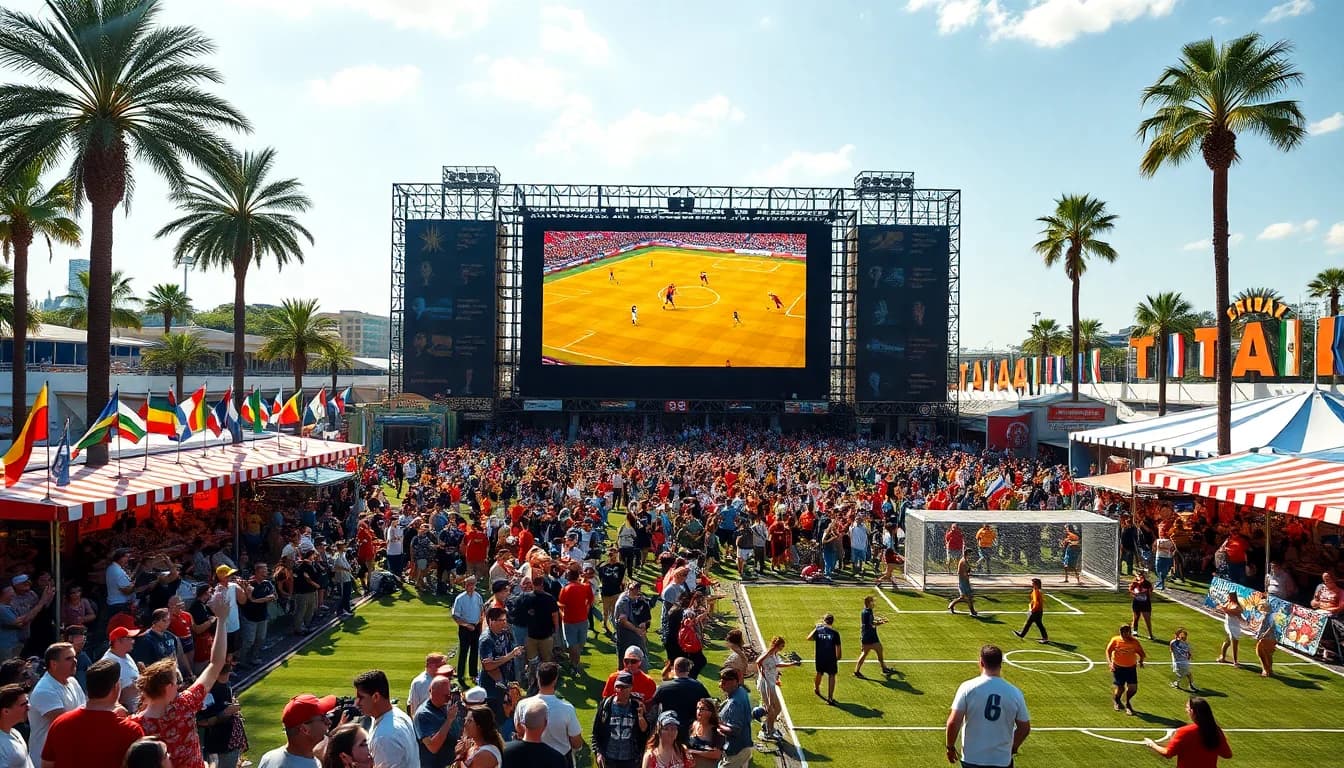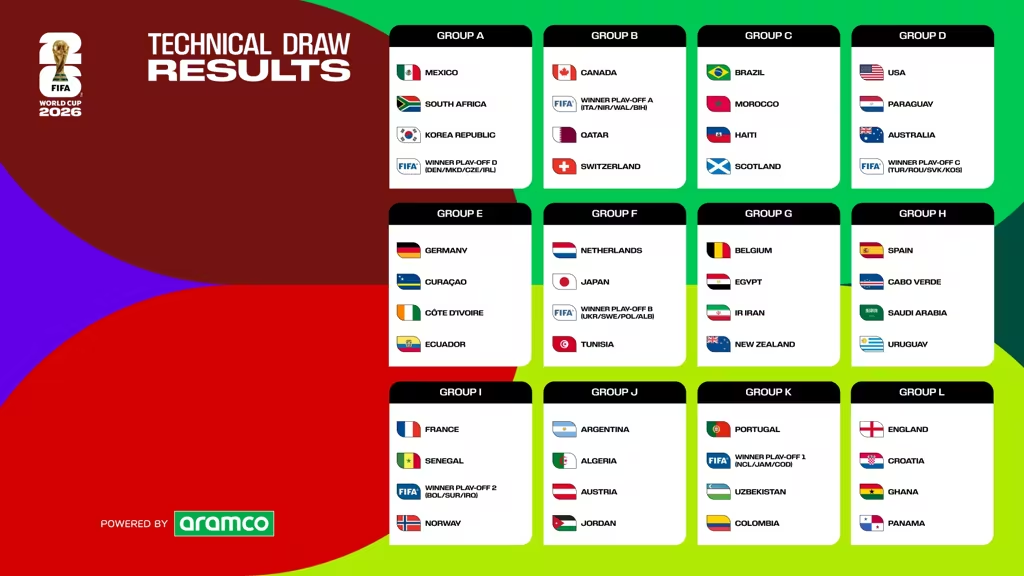
The FIFA World Cup 2026 is arriving in Dallas-Fort Worth, and by virtually every measure it will be the largest economic event North Texas has ever hosted. With AT&T Stadium in Arlington selected to host nine matches — the highest single-venue match allocation of any host city in the tournament — the economic footprint will be both enormous and enduring.
How Big Is This Event, Really?
To understand the scale, consider the numbers. Tourism economists and the DFW World Cup Host Committee estimate that hosting nine matches will generate approximately $400 million in direct and indirect economic activity across the Metroplex. That projection encompasses hotel room revenue, restaurant and retail spending, transportation services, ticketed events, and the cascading multiplier effects as those dollars circulate through the local economy.
Each major match at AT&T Stadium draws an on-site crowd of up to 93,000 spectators, but the economic footprint extends far beyond that. Visitors attending a single group stage match typically extend their stay by two to four days to experience Dallas, Fort Worth, and the broader Metroplex. Semi-final attendees, who may be traveling internationally, often build five-to-seven day itineraries. When multiplied across nine matches held over roughly five weeks, the total visitor-nights generated runs into the hundreds of thousands.
"The Super Bowl is often cited as the gold standard for one-time sports economic impact," noted a 2023 analysis by the U.S. Travel Association, which estimated that major global soccer tournaments generate more cumulative hotel demand than a Super Bowl due to the multi-week tournament structure, international visitor mix, and elevated average spending per party. The 2026 World Cup's eleven-city U.S. format means Dallas competes alongside Miami, Los Angeles, and New York as a major spending destination — and the nine-match allocation gives the Metroplex a longer runway than any other American venue.
Lessons From 1994: Dallas Has Done This Before
"Dallas proved in 1994 that it could host the world and deliver a world-class experience." — DFW World Cup Host Committee, official bid document submitted to FIFA (2017)
When the FIFA World Cup came to Dallas in 1994, matches were held at the historic Cotton Bowl in Fair Park, and the tournament's entire U.S. headquarters and International Broadcast Centre were established in the DFW Metroplex. That decision — to locate the operational nerve center of the 1994 tournament in Dallas — speaks to the region's logistics infrastructure and hospitality capacity.
The 1994 event generated approximately $300 million in economic activity for Dallas (equivalent to roughly $600 million in 2024 dollars, adjusted for inflation using Bureau of Labor Statistics CPI data). Hotels in the area reached 95 percent occupancy for match weeks. The Cotton Bowl, a venue with roughly 68,000 seats, was sold out for every match. International visitors from Brazil, Germany, Mexico, Italy, and dozens of other nations descended on Dallas and described the city as one of the most welcoming host destinations of the tournament.
Three decades later, the infrastructure is dramatically larger. DFW International Airport — ranked among the ten busiest commercial airports on earth according to Airports Council International 2023 traffic data — now handles over 73 million passengers annually. The hotel room inventory in the Metroplex has expanded from under 70,000 rooms in 1994 to more than 115,000 today. AT&T Stadium, opened in 2009, seats more than 93,000 with its standing-room configurations and dwarfs any venue that North Texas has previously used for a FIFA match.
The Hotel and Hospitality Boom
The hotel sector stands to benefit most immediately and most visibly. STR, the global hospitality analytics firm, projects average daily rates (ADR) for hotels within 15 miles of AT&T Stadium to increase by 200 to 400 percent during peak match weeks, particularly for the knockout-round matches and the semi-final on July 14, 2026.
That pricing surge, while challenging for budget travelers, creates a significant windfall for hotel operators and for the tax base. Dallas and Tarrant counties collect hotel occupancy taxes that fund arts programs, tourism marketing, and convention infrastructure. During the 2026 tournament window, those collections are expected to be at all-time highs.
Beyond hotels, the short-term rental market — Airbnb, VRBO, and competing platforms — will absorb additional demand, particularly from visiting fan groups and families who need multi-bedroom accommodations. The DFW Metroplex has one of the deepest short-term rental inventories in Texas, with tens of thousands of active listings across Dallas, Fort Worth, Arlington, Irving, Frisco, and surrounding communities.
Restaurants and retail establishments near AT&T Stadium, in the Dallas Entertainment District, in Uptown Dallas, and in Fort Worth's Sundance Square and Near Southside districts are already planning expanded staffing and menu offerings to capture World Cup spending. Food and beverage alone accounts for 15 to 20 percent of total visitor spending at major sporting events, according to the National Restaurant Association's 2023 event tourism research.
Infrastructure Investment and Legacy
The World Cup's arrival is accelerating infrastructure investments that will benefit the Metroplex well beyond 2026. The City of Arlington has invested in streetscape improvements along AT&T Way and in the Entertainment District connecting AT&T Stadium, Globe Life Field, and Texas Live! to improve pedestrian flow on match days. The North Central Texas Council of Governments has coordinated expanded express bus service between Dallas Union Station, Fort Worth's T&P Station, and Arlington for game days — a mobility improvement that will serve the corridor for years afterward.
DFW International Airport completed a significant expansion of Terminal F and has accelerated ground transportation improvements including expanded rideshare staging and a new rental car facility, both of which were partially motivated by projected World Cup traffic volumes.
Jobs and Workforce Opportunity
Economists estimate that hosting nine World Cup matches will directly support 3,000 or more temporary and permanent positions in the Metroplex, ranging from stadium operations, event security, and hospitality to transportation, translation services, and media production. Many of these roles will transition to permanent positions as hotels, restaurants, and entertainment venues that hired and trained staff for the World Cup retain workers to serve the enhanced visitor traffic that follows major global events.
The hospitality workforce development effect is particularly significant. Research by the American Hotel & Lodging Association found that cities that host FIFA World Cup or Olympic Games typically see sustained 8 to 12 percent growth in lodging employment in the two to three years following the event, as the marketing exposure drives long-term increases in leisure and international travel.
Small Business and Vendor Opportunity
Beyond the large hotel and restaurant chains, the World Cup creates significant opportunity for locally owned small businesses. Shuttle companies, food truck operators, tour guides, artisan vendors, entertainment venues, barber shops, souvenir manufacturers, and countless other businesses will see elevated demand from the 100,000-plus daily visitors who will be in the Metroplex on major match days.
The DFW World Cup Host Committee has established a local vendor program to connect small and minority-owned businesses with procurement opportunities for the tournament, including food and beverage concessions, merchandise, and transportation services. For businesses that successfully work the event, the relationship with World Cup operations can become a launching point for future major events.
Why Dallas Is the Right City for This Moment
In a tournament that stretches across eleven American cities — from Seattle to Miami, Boston to Los Angeles — Dallas-Fort Worth occupies a unique position. It is the most soccer-diverse major metropolitan area in the United States. With a population that is over 40 percent Hispanic or Latino, with established communities of Brazilians, Mexicans, Salvadorans, Nigerians, and citizens of over 100 other nations, the Metroplex is already home to the kind of multicultural, soccer-passionate community that makes a World Cup come alive.
The commercial infrastructure to support a global event is in place. The political will at the city, county, and state level is aligned. And the memory of 1994 — when Dallas told the world it was ready for the biggest stage in soccer — has only grown in the intervening decades. The $400 million projection is not wishful thinking. It is a conservative estimate for what happens when the world's most-watched sporting event meets one of America's most dynamic metropolitan regions.
What the Economic Impact Means for Local Residents
For DFW residents, the World Cup creates both opportunity and inconvenience that deserve clear-eyed assessment. On the opportunity side: lodging and hospitality workers will see expanded hours and overtime, ride-share drivers will benefit from surge pricing during match weeks, and small businesses near AT&T Stadium and along the Dallas-Fort Worth tourist corridor have a once-per-generation chance to capture customers who would never normally visit. Per the [U.S. Travel Association tourism impact research](https://www.ustravel.org/research), the long-tail effect of major sporting events on local employment can extend 18-24 months past the event itself as the marketing exposure drives sustained leisure travel.
On the inconvenience side: traffic congestion on I-30 between Dallas and Fort Worth will be severe on match days, hotel rates city-wide will be elevated even at properties 30+ miles from AT&T Stadium, and some restaurant reservations will become difficult to obtain weeks in advance. Per [North Central Texas Council of Governments transportation planning](https://www.nctcog.org/trans), expanded express bus and rail service is being coordinated to mitigate the worst traffic impacts, but residents should plan to use public transit or remote-work options on the nine match days. The [Federal Reserve Bank of Dallas economic research division](https://www.dallasfed.org/research) tracks regional economic indicators and will publish post-event analysis confirming whether the projected $400 million figure was met or exceeded.
Sources
1. [U.S. Travel Association — The Economic Impact of Major Events on Host Cities](https://www.ustravel.org/research) 2. [Airports Council International — Global Airport Rankings](https://aci.aero/) 3. [STR Global — Hotel Performance Forecasts](https://str.com/) 4. [Bureau of Labor Statistics CPI Inflation Calculator](https://www.bls.gov/data/inflation_calculator.htm) 5. [North Central Texas Council of Governments — Transportation Planning](https://www.nctcog.org/trans) 6. [Federal Reserve Bank of Dallas — Research](https://www.dallasfed.org/research)